
Meaning, memory and identity
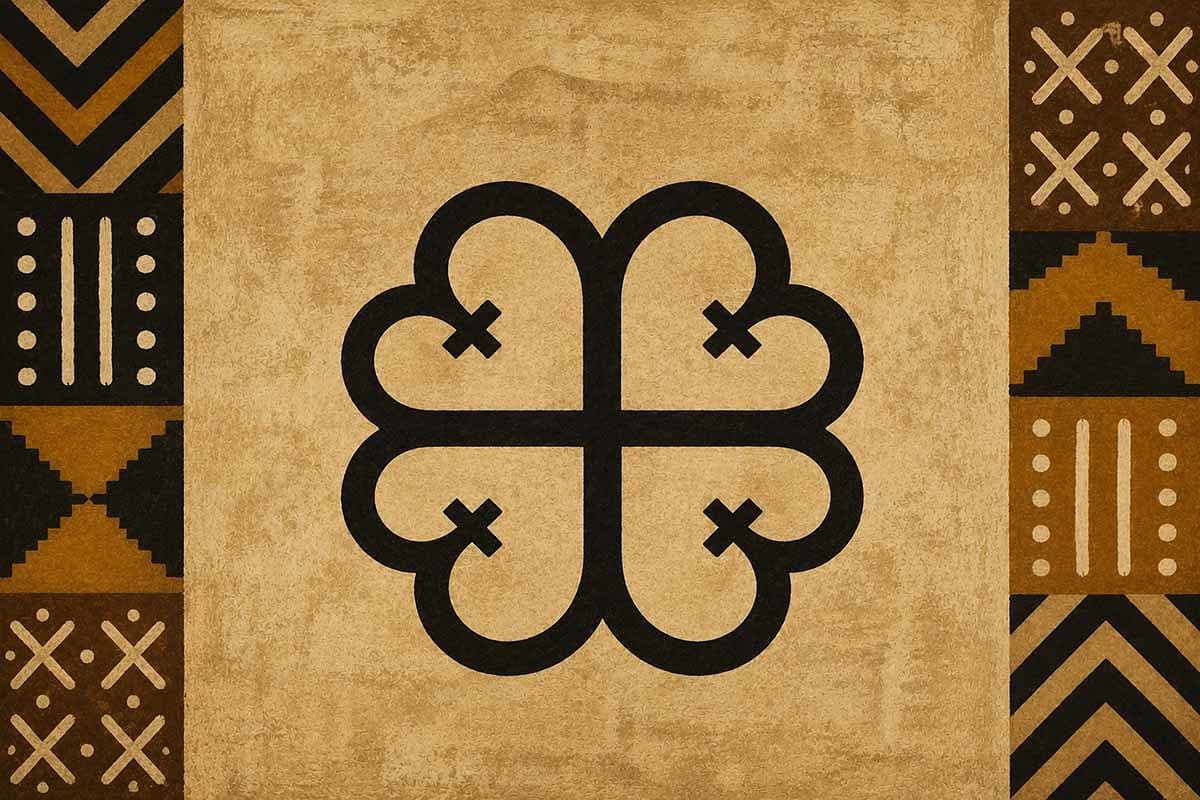
Nyame Dua, meaning "God's Tree" or "Tree of God", is the Adinkra symbol representing the presence and protection of God. A sacred altar post, it is placed at the entrance of homes and in courtyards as a sign that God dwells here and watches over those within.
Nyame Dua: God's Tree
Symbol Description
Nyame Dua is depicted as a tree or cross-like form with branching arms, sometimes with a pot or vessel at the top. In its traditional physical form, a Nyame Dua is a forked branch of a specific tree (the odum or odwen tree) placed upright in a pot of sand or earth at the entrance of a home. A vessel containing water, herbs and symbolic objects rests in the fork of the branch. This physical object is what is represented by the Adinkra symbol.
Meaning
"Nyame Dua" means "God's Tree" in Akan. The symbol represents:
- God's Presence: Just as a tree spreads its canopy to provide shade, God's presence spreads over and protects those who acknowledge it. The Nyame Dua is a visual declaration: "God is here."
- Divine Protection: The sacred post at the doorway of a home or sacred space marks it as under God's guardianship. Those who pass through are entering a protected space.
- Sacred Space: The presence of a Nyame Dua transforms an ordinary space into a sacred one, a place of prayer, healing and community.
- God's Blessings: The pot or vessel placed in the fork of the branch contains items offered to God, a gesture of gratitude and petition for continued divine favour.
The Nyame Dua in Akan Religion
Traditional Akan religion is not animistic in the simple sense, it does not worship trees or objects. Rather, the Nyame Dua is a focal point, a physical symbol that directs attention and devotion toward Nyame (God). It is similar in function to an altar or a sacred object in many world religious traditions.
The odum tree (Chlorophora excelsa) from which Nyame Dua branches are traditionally taken is itself regarded as sacred among the Akan, strong, long-lived and associated with divine power. The choice of this particular wood is deliberate and meaningful.
Placement and Ritual
A Nyame Dua is traditionally placed:
- At the entrance of a home (inside the courtyard)
- At the entrance of a chief's palace
- In communal gathering spaces
- At the beginning of important journeys or projects
The ritual of placing a Nyame Dua involves prayer, libation (pouring of drink on the ground as an offering to ancestors and to God) and sometimes the help of a traditional priest (okomfo). It is an act of consecration.
The Vessel in the Fork
The clay pot or vessel placed in the forked branches contains items that vary by tradition, but often include:
- Water (representing life and purification)
- White clay (associated with purity and the spirit world)
- Herbs with medicinal or spiritual properties
- Eggs (representing potential and new life)
These offerings are renewed periodically and are accompanied by prayer.
Nyame Dua in Contemporary Ghana
While fully traditional Nyame Dua practices are less common in urban Ghana, the symbol remains deeply meaningful. It appears:
- On Adinkra fabric, especially those used in spiritual and ceremonial contexts
- In artwork and design associated with Ghanaian spirituality and heritage
- As architectural detail in buildings inspired by traditional Ghanaian forms
- In the logos of organisations working in areas of traditional medicine, spiritual care and cultural heritage
The symbol in context
Photos, recordings and films from the collection
Photographs
3Prepared by Me Man Ghana Editorial Team
Learn at your level
Work through Beginner, Intermediate and Scholar questions without repeating the same prompt.
Community classroom
Join the conversation
Share a reflection, ask a question, or add what you know.
Sign in to save progress and join the discussion.
No reflections yet. Start the conversation.
Reflections
0