
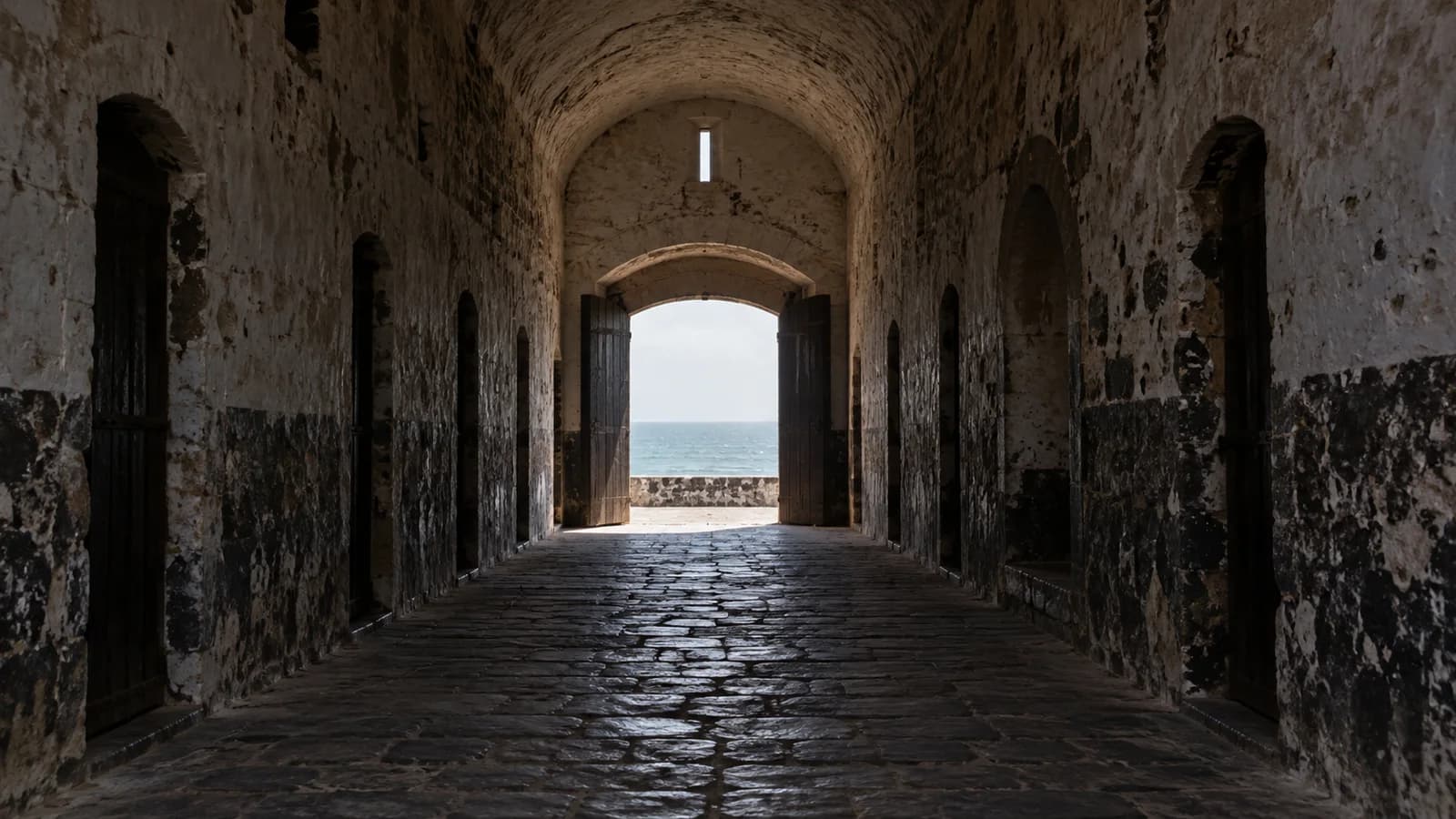
The coast of present-day Ghana contains a remarkable concentration of forts and castles built by European trading powers from the late fifteenth century onward. Elmina Castle began as a Portuguese trading post in 1482, while Cape Coast Castle developed under several European powers before becoming a major British base.
These buildings first supported commerce in gold and other goods. As Atlantic plantation economies expanded, many became prisons and embarkation points in the trafficking of enslaved Africans. Captives reached the coast through warfare, raiding, kidnapping, judicial enslavement and trading networks that involved both African and European actors operating under profoundly unequal and violent conditions.
Men and women were confined in overcrowded dungeons before being forced onto ships. The number who passed through individual forts is difficult to establish, and the experience cannot be reduced to a single doorway or statistic. The wider system displaced millions of Africans and reshaped societies on both sides of the Atlantic.
The trade enriched European empires and merchants while encouraging violence and political instability in parts of West Africa. African states and merchants participated in the trade in different ways, while individuals and communities also resisted capture, escaped and sought to protect themselves. Recognising this complexity does not lessen the responsibility of the Atlantic system or the suffering it caused.
UNESCO inscribed Ghana's forts and castles as a World Heritage property in 1979. Today they are places of remembrance, education and diaspora encounter. Their preservation asks visitors to confront the human consequences of slavery and to listen to the many communities whose histories are connected to these sites.
Reflections
0