
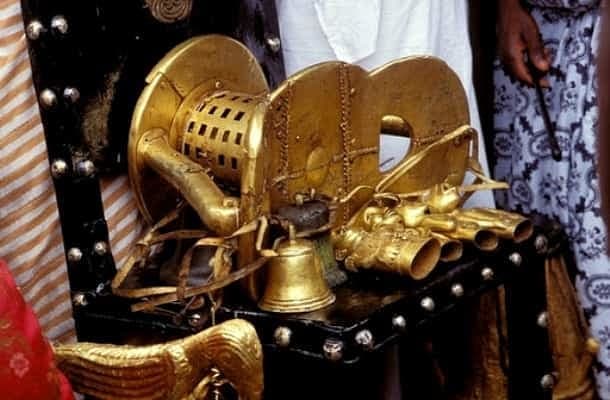
The Golden Stool, known as Sika Dwa Kofi, is the most sacred symbol of the Asante nation. Asante oral tradition says that the priest Okomfo Anokye brought it down from the sky during the reign of Osei Tutu as the Asante union was being formed around the end of the seventeenth century.
The stool is understood to contain the collective spirit of the Asante people rather than to belong personally to a ruler. No one sits on it, including the Asantehene. At important ceremonies it has its own place and is handled according to strict protocols.
Descriptions of its construction indicate a carved wooden stool covered with gold, rather than a throne made from a single mass of solid gold. Its significance comes from the political and spiritual covenant it represents, not simply from precious material.
In 1900, Governor Frederick Hodgson's demand for the stool helped trigger the final major Asante war against British rule. Asante defenders kept it hidden, and the British never captured it. Its survival represented continuity even after formal annexation in 1902.
The original is closely protected and is not an object for casual display. Many photographs and museum objects described as “Golden Stools” are replicas or related ceremonial stools. Respecting that distinction is part of understanding the living institution rather than treating a sacred object as a museum curiosity.
Reflections
0