
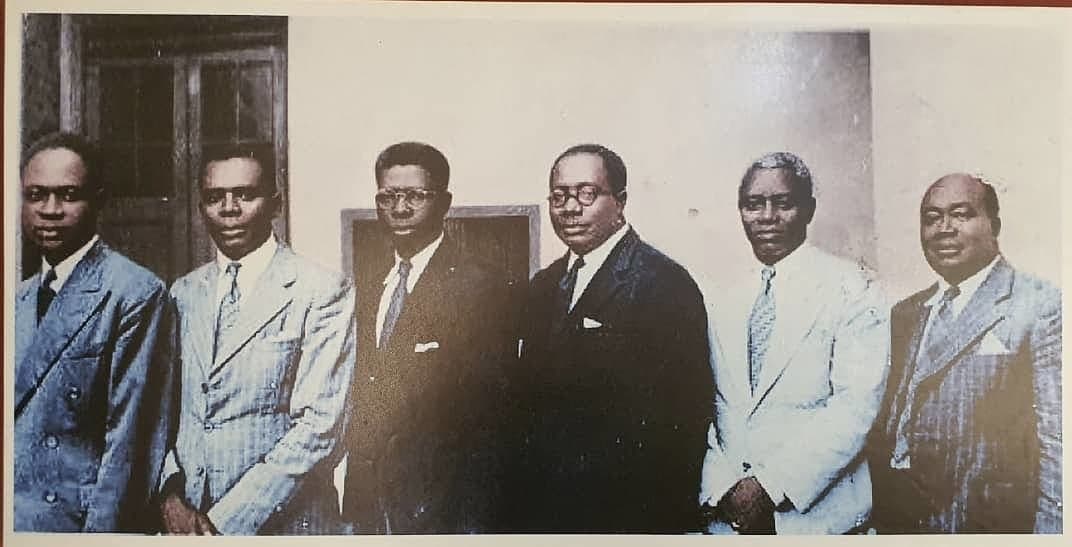
Six leaders, one movement On 4 August 1947, in the coastal town of Saltpond, a group of lawyers, teachers and businessmen founded the United Gold Coast Convention (UGCC). Its aim was self-government "in the shortest possible time". The idea and much of the money came from a merchant, George Alfred "Paa" Grant, who became the party's president, while the lawyer and scholar J.B. Danquah supplied much of its intellectual direction. Six of the UGCC's leaders would go down in history as the Big Six. The name did not come from a party office or a title. It came from what happened to them in March 1948, when the colonial government arrested and detained all six together after the Accra riots. Today they are remembered as the founding fathers of Ghana.
Who were the Big Six?
- Kwame Nkrumah (1909–1972): Returned to the Gold Coast in December 1947 after more than a decade abroad to take up the UGCC's full-time secretary post. He later led the country to independence and became Ghana's first prime minister and first president.
- J.B. Danquah (1895–1965): A lawyer, scholar and author from the Akyem Abuakwa royal family, described by the Watson Commission as the "doyen" of Gold Coast politics. He is widely credited with suggesting the name "Ghana" for the independent nation.
- Ebenezer Ako Adjei (1916–2002): A lawyer and journalist who studied in the United States and Britain. He recommended Nkrumah for the UGCC's full-time post, and later served in Nkrumah's governments, including as Minister of Foreign Affairs.
- Edward Akufo-Addo (1906–1979): A lawyer trained at Oxford and the Middle Temple who later served as Chief Justice (1966–1970) and as Ghana's ceremonial president (1970–1972). He is the father of Nana Akufo-Addo, president from 2017 to 2025.
- William Ofori Atta (1910–1988): Known as "Paa Willie", a lawyer educated at Achimota and Cambridge and a son of Nana Sir Ofori Atta I, the Okyenhene of Akyem Abuakwa, whose brother was J.B. Danquah. He later served as Minister of Foreign Affairs in Ghana's Second Republic.
- Emmanuel Obetsebi-Lamptey (1902–1963): A Ga lawyer from Accra, affectionately called "Liberty" Lamptey. He is remembered for his bold, confident leadership in the UGCC, and the Obetsebi-Lamptey Interchange in Accra carries his name.
From the 1948 riots to detention By early 1948 the Gold Coast was tense. Prices were high, and ex-servicemen who had fought for Britain in the Second World War were angry about unpaid benefits and neglect. On 28 February 1948 police fired on a march of veterans heading for Christiansborg Castle, killing three of them. Riots followed in Accra and other towns. Our article on the 1948 Accra riots tells that story in full.
The UGCC leaders, who had backed the veterans, cabled London demanding a change of government and offering to take over an interim administration. The governor, Sir Gerald Creasy, ordered their arrest, and in March 1948 the six were taken away and held in the north of the colony, far from Accra. The detention backfired. Public anger grew, and London sent the Watson Commission to investigate the causes of the disturbances. It concluded that the Gold Coast needed a new constitution, and a constitutional committee followed, the Coussey Committee, which included Edward Akufo-Addo. The men who had been jailed for challenging colonial rule were now at the center of the debate about what should come next.
Paths that split The unity did not last. Nkrumah, impatient with the UGCC's cautious pace, broke away in June 1949 and formed the Convention People's Party (CPP) under the slogan "Self-Government Now". He launched "Positive Action" in January 1950, was jailed, won a seat in the 1951 election from prison, and led the Gold Coast to independence on 6 March 1957, when it became Ghana. The other five took different roads. J.B. Danquah and William Ofori Atta became leading figures of the opposition, and the years after independence were hard for them. Under the Preventive Detention Act, opponents of the government could be held without trial: Danquah died in detention in 1965, and Ofori Atta was also detained. Ako Adjei, who had served in Nkrumah's government, was himself detained in 1962 over the Kulungugu bomb attack and released only after the 1966 coup that overthrew Nkrumah. Obetsebi-Lamptey died in 1963. Edward Akufo-Addo went on to the bench and, after the return to civilian rule, to the presidency. Nkrumah died in exile in 1972 and was reburied in Accra in 1992.
More than six The name Big Six can hide how broad the struggle was. Paa Grant, who founded and financed the UGCC, was not among the six. Neither were the ex-servicemen who marched to Christiansborg, among them Sergeant Cornelius Frederick Adjetey, Private Odartey Lamptey and Corporal Attipoe, who were killed, nor the chief Nii Kwabena Bonne III, who led the January 1948 boycott of imported goods, nor the many chiefs, teachers, trade unionists and students who built the movement. The six are best understood as the most visible faces of a much larger effort. How much credit each of the six deserves is still debated in Ghana. Nkrumah's supporters and the Danquah–Busia political tradition have long told the story differently, and some argue that the recognition given to the others should be shared more widely.
Remembering the Big Six They are honoured as founding fathers and national heroes rather than as official national symbols like the flag, the coat of arms or the anthem. Founders' Day, marked each year on 4 August to recall the founding of the UGCC in 1947, was created to honour them together. In Accra, the Kwame Nkrumah Mausoleum and Memorial Park pays tribute with illuminated portrait panels, and the UGCC's old national headquarters still stands in Saltpond, where the movement began.
Reflections
0