
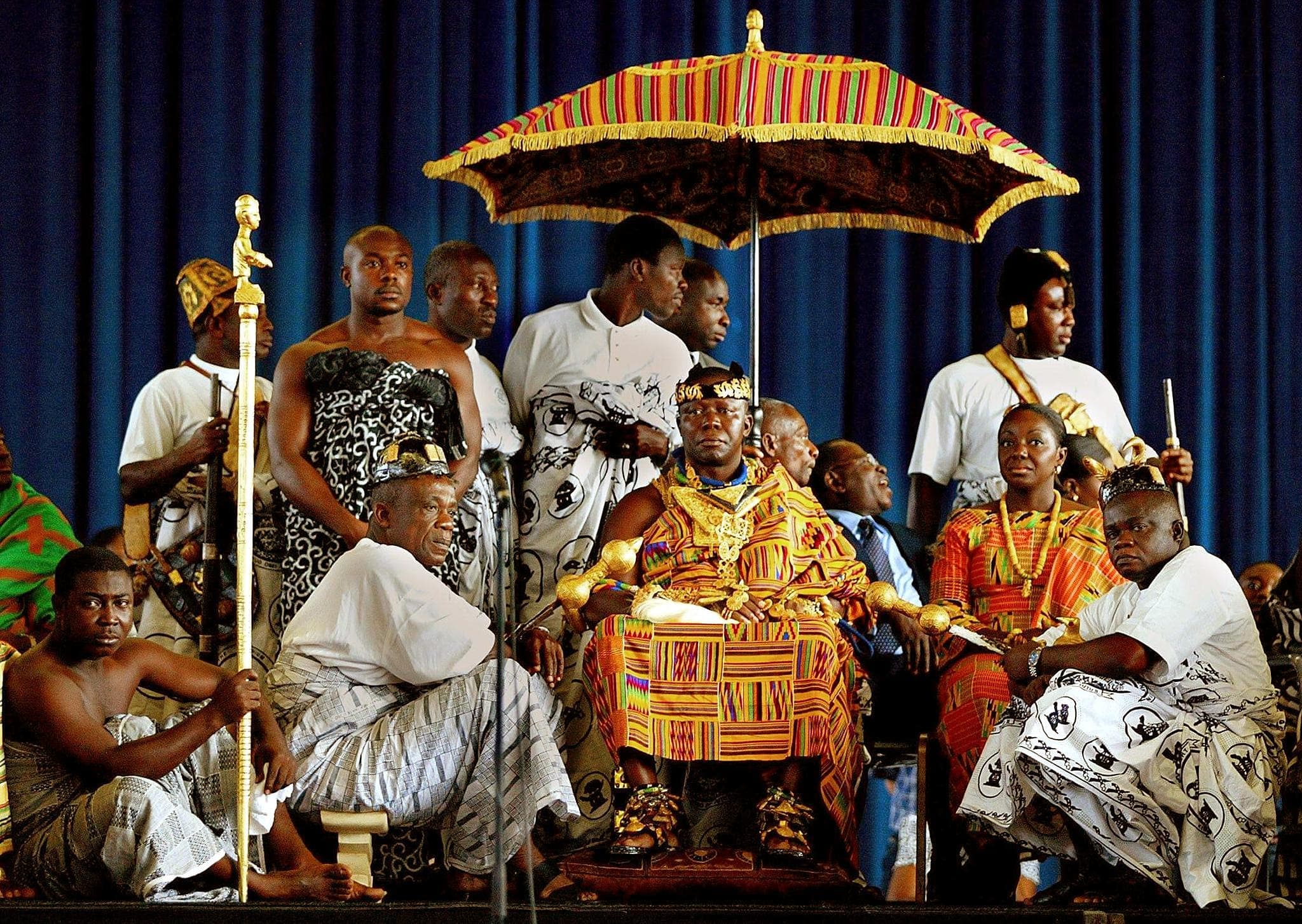
The Asante state emerged around Kumasi in the late seventeenth century. Osei Tutu and the priest Okomfo Anokye are central to traditions about unifying several Akan polities, with the Golden Stool representing their shared political and spiritual union.
Victory over Denkyira at the beginning of the eighteenth century opened access to trade routes and helped Asante expand. Through warfare, diplomacy and tribute, the state grew across much of the region now called Ghana. Its boundaries and influence changed repeatedly rather than forming a fixed modern map.
Government linked the Asantehene and councils at Kumasi with rulers of constituent states. Officials managed diplomacy, taxation, courts and military organisation. Gold mining and trade were major sources of wealth, alongside agriculture and kola. The state also participated in systems of slavery and the Atlantic trade in captives, a necessary part of its history as well as its achievements.
Asante fought several wars with British forces and their African allies during the nineteenth century. British troops occupied Kumasi in 1874. In 1896 they deposed and exiled Prempeh I, and the resistance war of 1900 was followed by formal annexation in 1902.
Prempeh I returned from exile in 1924. The Asante Confederacy was formally restored under Prempeh II in 1935, within the colonial order. Since Ghanaian independence, the Asantehene and traditional institutions have continued to exercise major cultural and customary authority within the republic.
Asante history is visible today in language, festivals, court arts and political memory. It includes sophisticated government and artistic achievement, as well as conquest, enslavement and conflict. Holding these dimensions together gives a fuller account of one of West Africa's most influential states.
Reflections
0