
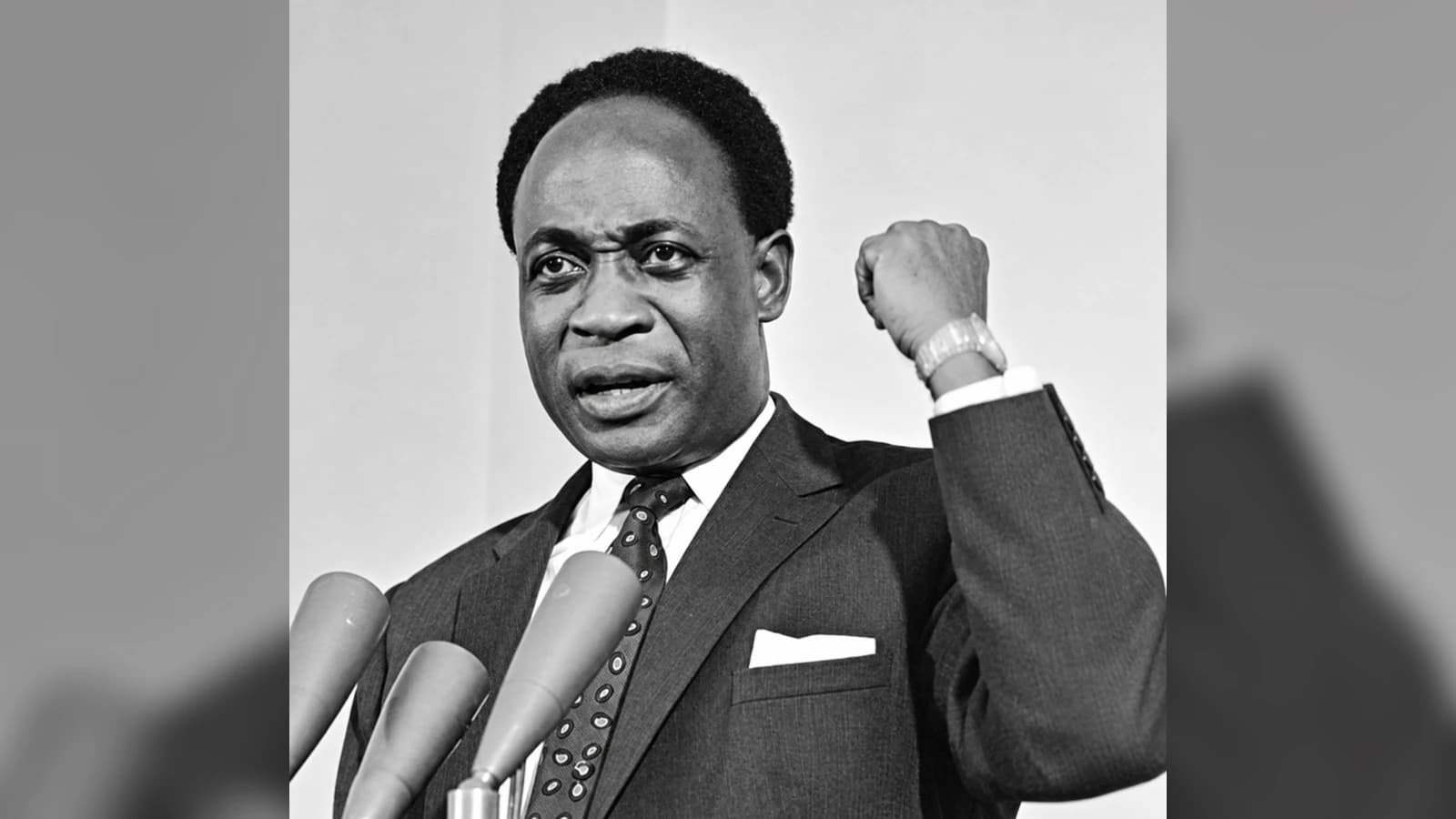
Kwame Nkrumah was born at Nkroful in the Gold Coast, probably on 21 September 1909. After training as a teacher at Achimota, he studied in the United States at Lincoln University and the University of Pennsylvania. His years abroad exposed him to Black internationalism, socialism and Pan-African organising.
Nkrumah helped organise the Fifth Pan-African Congress in Manchester in 1945 and returned home in 1947 to serve as general secretary of the United Gold Coast Convention. He later broke with the UGCC and founded the Convention People's Party in 1949, demanding “self-government now.” Imprisoned during the Positive Action campaign, he won election from prison in 1951 and was released to lead government business.
He became prime minister of independent Ghana on 6 March 1957 and president when Ghana became a republic in 1960. His governments greatly expanded schools, roads, health services and industrial projects. Tema Harbour and the Akosombo Dam became defining symbols of the development programme, although their high costs and dependence on cocoa revenue contributed to mounting economic pressure. The University College of the Gold Coast had opened in 1948; Nkrumah's government later supported its development into the independent University of Ghana in 1961.
Nkrumah regarded Ghana's freedom as inseparable from the liberation of Africa. Accra hosted Pan-African conferences and anticolonial activists, while Nkrumah argued for continental political union. He played a leading role in the creation of the Organisation of African Unity in 1963.
His record also became increasingly authoritarian. The Preventive Detention Act permitted imprisonment without trial, opposition was restricted, and Ghana became a one-party state in 1964. Economic difficulties and discontent grew. While Nkrumah was travelling to Hanoi in February 1966, Ghana's military and police overthrew his government.
Nkrumah lived in Guinea after the coup and died in Bucharest in 1972. His legacy remains both influential and contested: he is honoured for independence, Pan-Africanism and ambitious nation-building, while his concentration of power continues to shape debate about leadership and democracy.
Reflections
0