
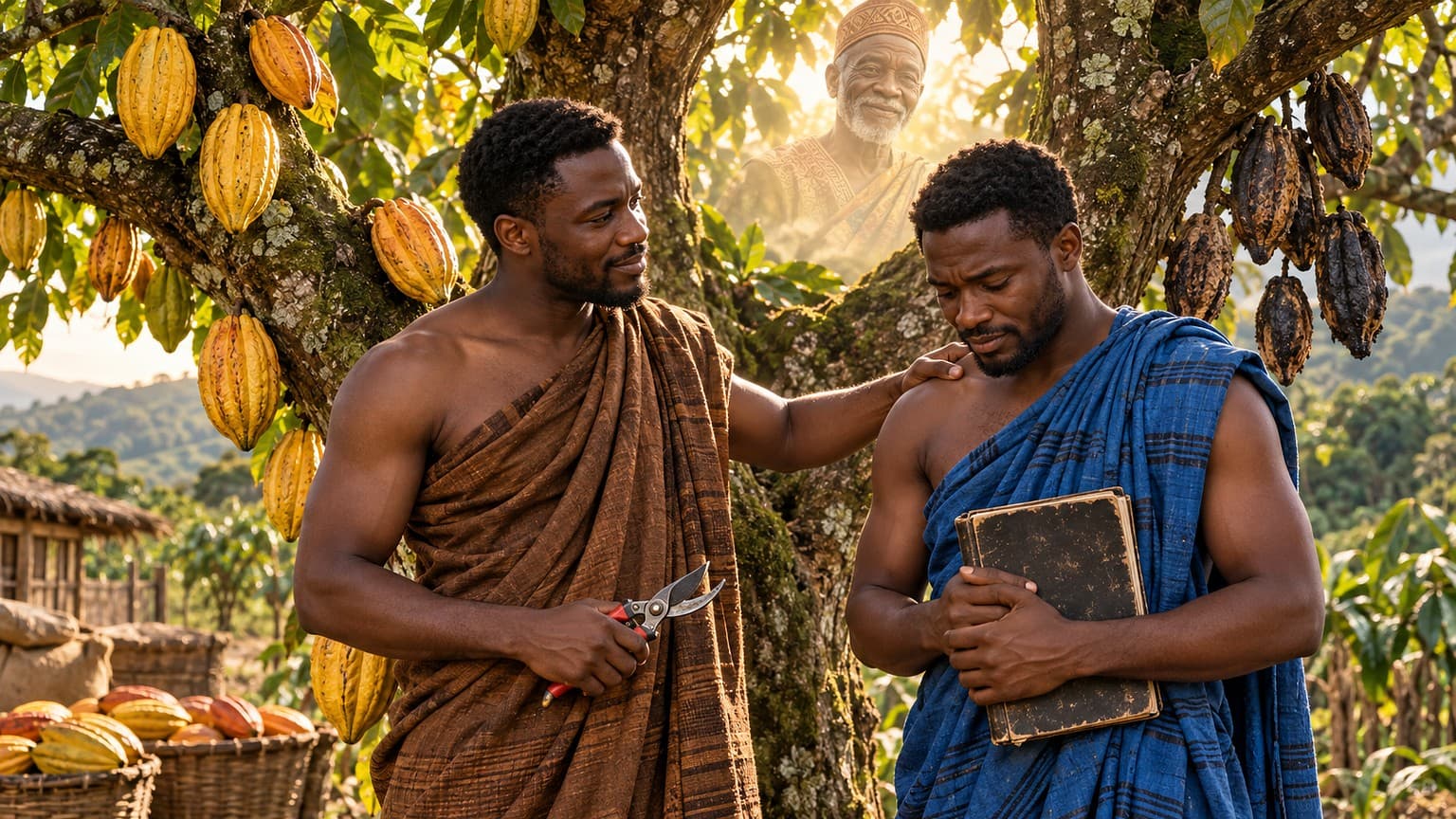
Kofi and Kwame were brothers who could not have been more different, though they shared the same father, the same face, and the same inheritance: thirty acres of cocoa farm in the hills of Ashanti.
Their father, old Yaw Asante, had worked those hills for fifty years. Every tree he had planted himself. He knew each one by the shape of its pods, by the thickness of its shade. When he died, he gathered his sons and said: "The farm is yours together. Whatever you do with it, do it honestly, for the trees will know, and the trees will tell."
Kofi, the elder, rose before dawn each morning. He pruned the trees, cleared the weeds, checked for the black pod disease that could ruin a harvest in a week. He kept detailed records of every bag of beans sold, every cedi earned, every expense paid. He treated the workers fairly and paid them on time.
Kwame, the younger, told himself he was working "smarter, not harder." He hired a foreman to manage the farm while he attended to "business contacts" in the city. He borrowed against the farm's future harvest to buy fine cloth and a motorbike. He sold some premium pods to a separate buyer without telling Kofi, pocketing the difference.
For two seasons, Kwame's tricks worked. He seemed prosperous while Kofi seemed merely hardworking.
But in the third season, the black pod disease came. Without the careful pruning and vigilance that Kofi maintained, Kwame's half of the farm was devastated. Three-quarters of his pods rotted on the branch.
Kofi's half, carefully maintained, lost only a quarter of its yield.
When the farm's accountant presented the books, Kwame's secret sales were discovered. The foreman, feeling wronged, told everything. The workers Kwame had underpaid refused to return.
Kofi could have driven his brother away. The farm was half his, and the law would have supported him. Instead, he sat with Kwame under the oldest cocoa tree, a giant their grandfather had planted, and said: "Father said the trees would know and the trees would tell. They have told. Now we start again."
The brothers reorganised. Kwame came back to the farm. He learned, slowly, to do what Kofi had always done: to arrive before dawn, to know each tree, to deal honestly. It was harder than scheming, but the farm slowly recovered.
Years later, when their own children inherited the farm, it was larger and more productive than it had ever been. And the brothers' children told the story: the farm did not belong to whoever worked hardest or schemed the most; it belonged to whoever was honest enough to be trusted with it.
What lesson travelled with this tale?
Finish the story, reflect on its choices, then reveal the wisdom it carries.
Reflections
0