
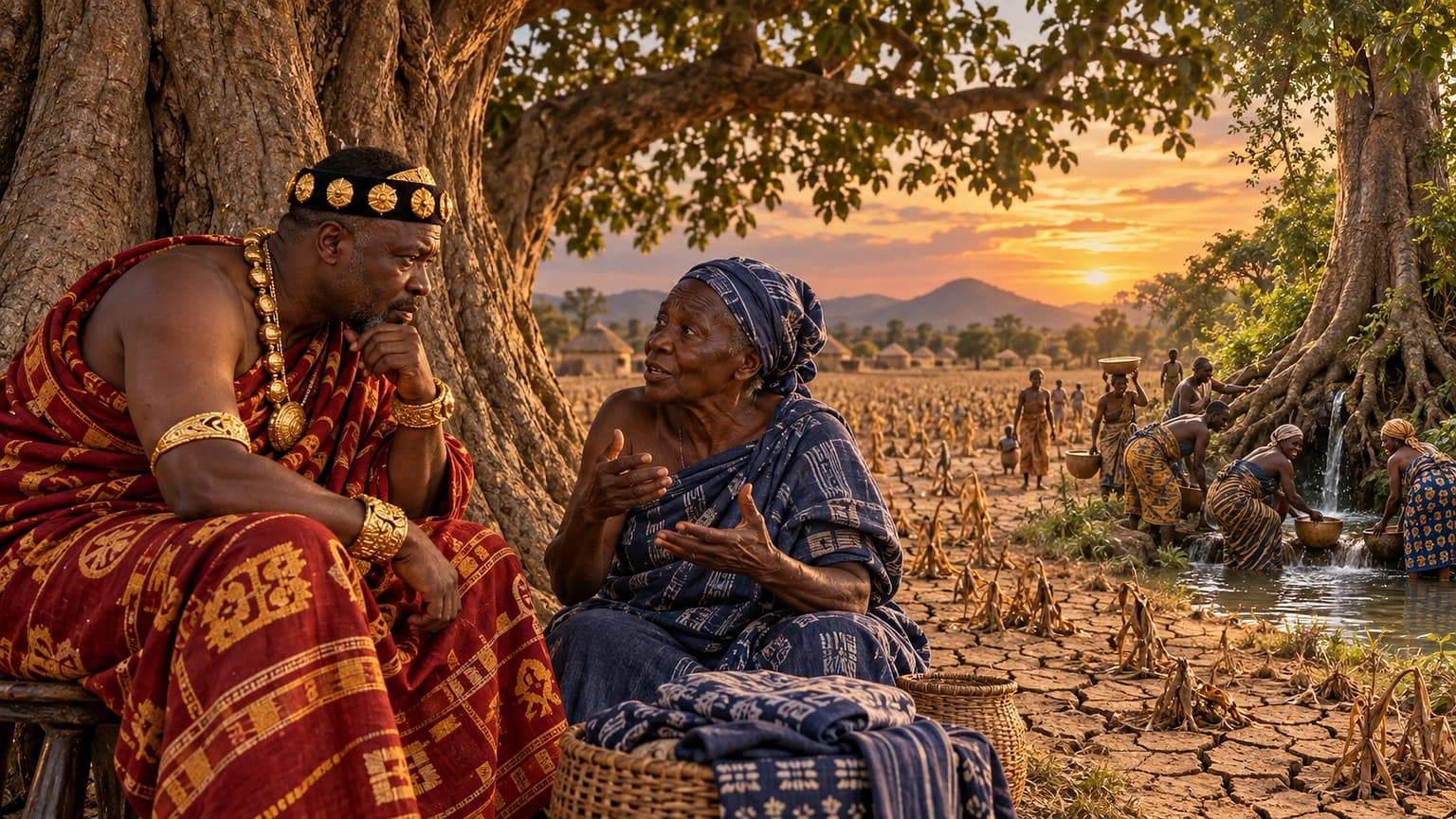
In the eastern Akan territories, there lived a chief named Opoku Frimpong whose kingdom stretched across seven villages and twelve farmlands. He was known for his just rulings and his love of council, every morning, he would gather his elders and warriors beneath the great odum tree at the centre of his compound, and no decision would be made without their agreement.
But one year, a drought descended on the land. For four months, not a cloud crossed the sky. The rivers shrank to muddy trickles. The cocoa pods fell from the trees before they ripened. Children grew thin, and the old people began to cough at night.
Chief Opoku called his council. The eldest elder said: "We must sacrifice to the river gods." The war chief said: "We must send men to trade our stored goods for food in the north." The chief priest said: "The ancestors are angry. We must perform the great purification ceremony." Each spoke with authority, and each contradicted the others.
Days passed. The ceremonies were performed, the sacrifices made, the traders sent north, and still no rain came. The people began to whisper that their chief had lost the favour of Nyame.
One evening, as Opoku sat alone under the odum tree, an old woman named Akua Serwaa approached. She was not a titled person; she was a cloth-seller who had lived in the village all her eighty years. Most of the elders did not acknowledge her when she passed.
"Chief," she said, bowing, "I ask permission to speak."
"Speak," said Opoku, more from loneliness than expectation.
"The young men dig for water in the wrong places," Akua Serwaa said. "My grandmother told me that in the last great drought, the water went underground to the west, beneath the grove of mahogany trees, where the roots go deepest. My grandmother's grandmother found water there."
The chief was silent for a long time. His elders had not mentioned this. But something in the old woman's certainty moved him.
The next morning, he ordered digging to the west. The elders protested: "We have always dug to the east." But Opoku overruled them.
On the third day of digging, water surged up from the earth, cold, clear, abundant. The village rejoiced. The water sustained them until the rains returned six weeks later.
When the elders asked how the chief had known where to dig, Opoku said simply: "I listened to someone whose voice I had not thought to ask for." He turned to where Akua Serwaa stood at the edge of the crowd, and she bowed.
From that day forward, Chief Opoku invited not only titled elders to his morning councils, but also two ordinary villagers, one man and one woman, chosen by lot each week. His kingdom became famous not just for its lands but for its wisdom, and it prospered long after other kingdoms fell.
What lesson travelled with this tale?
Finish the story, reflect on its choices, then reveal the wisdom it carries.
Reflections
0