
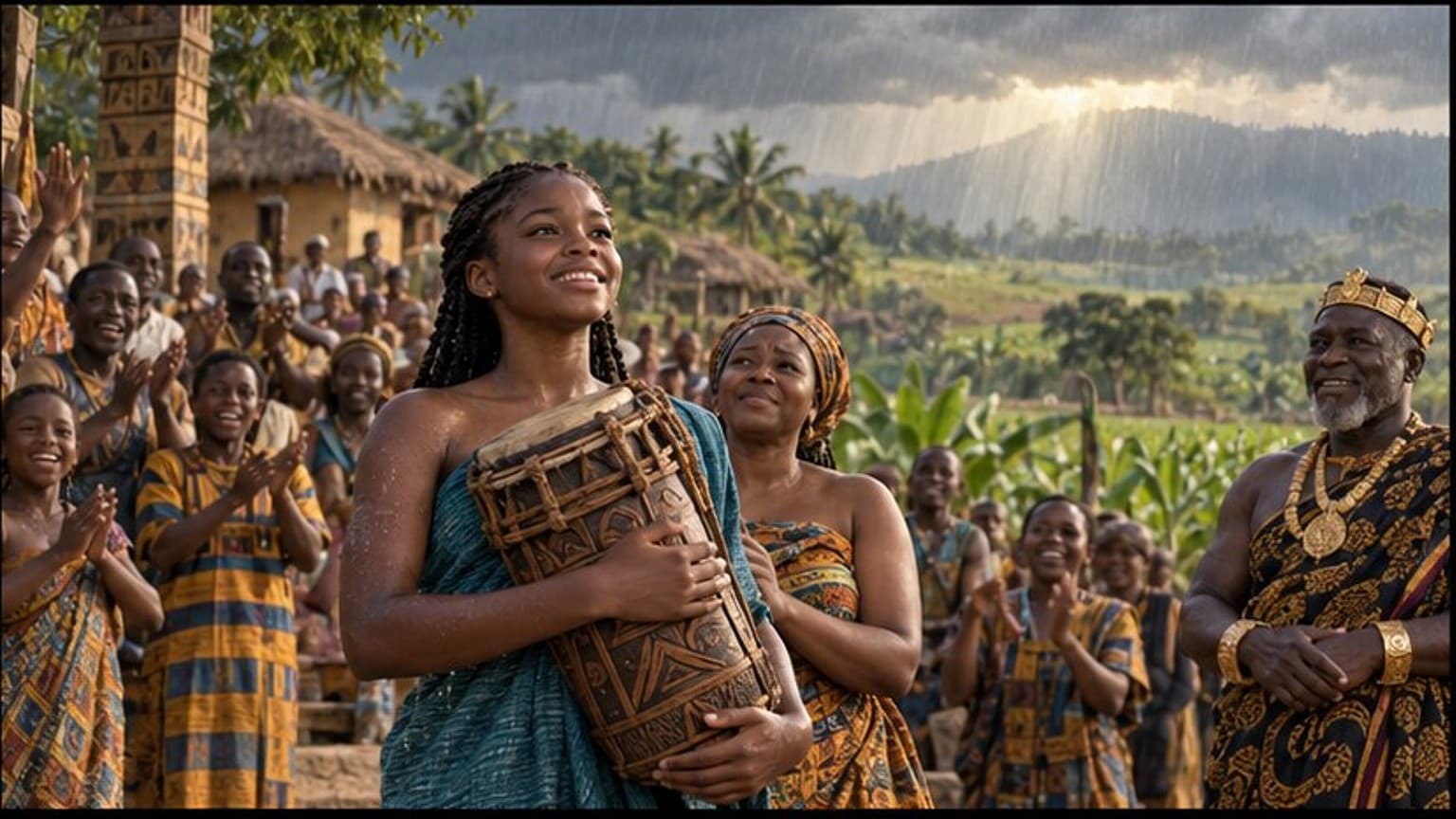
In a village nestled beside the River Tano, there was kept a sacred drum whose beating could bring rain in the dry season, drive away sickness, and call the ancestors home for the great festivals. It had been in the village since the time of the grandmothers' grandmothers, and its voice was the voice of the village itself.
One night during the great floods, the river rose beyond its banks and swept through the lower village. By morning, the water had receded, but the sacred drum was gone. It had been carried into the deep waters of the Tano and lost somewhere in the cold, fast currents beneath the surface.
The chief called for volunteers to retrieve it. Three warriors dived in succession into the deepest part of the river. The first came up gasping, saying the current was too strong. The second did not surface for so long that the people wept, but he finally came up, empty-handed, having seen nothing in the dark water. The third refused to dive at all once he saw how deep the river was.
The chief sat on his stool, his hands covering his face. Without the drum, the dry season would come without the ancestors' guidance.
A young girl named Abena, thirteen years old, the daughter of the village weaver, stepped forward. "Let me try," she said.
The elders laughed. The warriors looked away. Even her own mother grabbed her arm.
But the chief raised his hand for silence. He looked at Abena for a long time. She was not large or particularly strong. But her eyes were calm and serious, with no trace of bravado.
"Why do you think you can do what three warriors could not?" he asked.
Abena said: "Because I am not going to fight the river. I am going to ask it."
She walked to the edge of the Tano and knelt. She spoke quietly, in the old language of the river songs her grandmother had taught her, the songs the Tano people had always used when asking the river for its gifts. She asked permission. She promised respect. She said the village missed the drum not for power but because they missed the voice of the ancestors.
Then she dived.
She was under for longer than any of the warriors. The people held their breath. The chief's hands gripped his stool.
When Abena surfaced, she had the drum. It was waterlogged but unbroken.
The people erupted in celebration. When the noise died down, the chief asked: "What happened beneath the water?"
Abena wrung the water from her cloth. "The river spirit showed me where it was," she said simply. "I think it was waiting for someone to ask properly."
The drum was dried and restored. That year's dry season ended three weeks early, and the rains came in abundance. Abena became the drum keeper, a role that had never before been given to a girl. She held it for sixty years, and the drum never left the village again.
What lesson travelled with this tale?
Finish the story, reflect on its choices, then reveal the wisdom it carries.
Reflections
0